Kid Hopping on One Leg Squeaky Word Clip Art
Main Trunk
Chapter 8: Music in Early Childhood Development
Chapter Summary: This chapter focuses on the office of music in early childhood, including the importance of musical experience in early on childhood, the musical abilities and enjoyment of infants and children, and the vocal ranges of the young child. Information technology as well explores musical activities and repertoires appropriate for young children.
What a child has heard in his first six years of life cannot exist eradicated afterwards. Thus it is likewise late to begin education at school, because a child stores a mass of musical impressions before schoolhouse historic period, and if what is bad predominates, then his fate, as far as music is concerned, has been sealed for a lifetime.
—Zoltán Kodály, Children's 24-hour interval Spoken language, 1951
Arts as a Means of Expression for Young Children
How important are the arts as a mode of expression for children? Children, especially very young children, cannot express themselves fluently either through speech or writing—two modes of communication that adults utilize virtually exclusively. Instead, children express themselves through motion, audio, and art. If they tin express themselves through these modes, it is logical that they can learn through them as well.
Many times, however, adults are at a loss to empathize or interpret what it is children are saying to u.s.a., or to appreciate how profound it might be. Marking E. Turner (2008), building upon the work of Edwin Gordon and Reggio Emilia, idea considerably about children'southward representation through the arts. He sought to provide authentic ways for children to express themselves and adult scaffolding to better harness and sympathise children's musical development. As Turner states, the idea that the "performing arts" must always be performed onstage to exist valid detracts from their utilize to develop and explore the emotional, cognitive, social evolution and human potential.
Music for Young Children
Any of the music methods (east.g., Kodály, Orff) mentioned in Chapter 4 offering sequential learning for children. Kodály in particular spent a great deal of effort on developing cute singing voices for immature children. Children's voices, after all, are their first instrument—a kid'due south first uncommonly pleasant musical experience is likely to be hearing lullabies from a parent or guardian, and so vocally experimenting with his or her own voice. Kodály graded learning in small steps for the very beginner learners, starting with three-note songs (sol, mi, la) and expanding gradually to 4, five, and half dozen notes and across. For the youngest, songs with three notes are an excellent place to start, considering these children volition not have much difficulty imitating or matching these pitches and tin can be successful from the showtime.
I. Music for Children Birth to Three Years Old
Music action for infants and toddlers engages the child'southward aural and concrete being. Such age-old activities include tickling, wiggling, bouncing, and finger playing.
At this level, musical play creates and reinforces the special personal bond between an adult (or older child) and infant, while also introducing music to the child. For newborns and very young children, speaking a rhyme and wiggling toes connects audio to a pleasurable and intimate act, too as introducing the idea of rhythm and phrasing to newborns and immature children.
Below are a few of the rhymes and songs particularly good for newborns and toddlers. They include some very familiar plant nursery rhymes and action games appropriate for this age grouping. Keep in mind that almost whatsoever nursery rhyme tin be used for these activities, as long as they accept a steady shell, which luckily virtually of them do.
Bounces
For newborns to three-year-olds, having them feel the beat in their bodies, aided past adults, are chosen "bounces," based on the feel of bouncing a kid up and down on a knee or lap.
Bumpity Bump


Tommy O'Flynn


Tommy O'Flynn and the former grey mare (bounce child on knees)
Went to see the country fair
The bridge roughshod down and the bridge fell in (open knees and let kid drib a bit)
And that was the end of Tommy O'Flynn
Wiggles
Wiggles are those activities involving the wiggling of fingers or toes. "This Lilliputian Piggy Went to Market" is another wiggle with which y'all may be familiar.
The first little pig danced a merry, merry jig
The 2d fiddling pig ate candy
The third little hog wore a blue and yellow wig
The 4th niggling squealer was a dandy
The fifth fiddling pig never grew to be big
And so they called him Tiny Lilliputian Andy
Tickles
Tickles involve exactly that—tickling the child either all over or just in the stomach, usually ending in lots of giggles!
Slowly, slowly, very slowly up the garden trail (clamber easily upwardly baby starting from feet)
Slowly, slowly, very slowly creeps the garden snail (continue crawling)
Rapidly, quickly, very speedily all around the business firm (tickle all over)
Speedily, quickly, very quickly runs the fiddling mouse (continue tickling)
My male parent was a butcher (make chopping motions on child'due south trunk)
My mother cuts the meat (brand cutting motions on child'southward body)
And I'm a little hot dog
That runs around the street (tickle all over)
Pizza pickle pumpernickel
Pizza, pickle, pumpernickel (flash one hand wide, then the other, then roll arms)
My little one shall accept a tickle! (tickle kid)
One for your olfactory organ (tickle kid's nose)
And one for your toes (tickle kid's toes)
And 1 for your breadbasket, where the hot dog goes! (tickle child's tummy)
Finger Play
Finger play songs can likewise be types of tickles. The most mutual finger play vocal is the "Eensy, Weensy Spider."
Eensy Weensy Spider




Tapping
For an baby, the parent would accept the child'southward pes or manus and tap it to the beat of the music. If the kid can tap by him- or herself, that will work besides.
Erect a Doodle Practise
English nursery rhyme, 1765



Cock-a-doodle doo (tap 1 human foot)
My dame has lost her shoe
My chief's lost his picayune stick
And doesn't know what to practise.
Cock-a-putter doo (tap other foot)
What is my dame to practice?
Til chief finds his piddling stick
She'll dance without a shoe.
Cock-a-doodle doo (tap both feet)
My dame has found her shoe
And master'southward establish his trivial stick
Sing putter, putter, doo.
Clapping (Nine+ Months)
Equally children develop physically, they can clap their hands either together or confronting those of another. The well-known "Patty Block" is a adept example.
Patty Cake
Patty block, patty block, bakery's homo
Bake me a cake as fast as y'all can
Roll information technology and pat information technology and marker it with a "B"
And put it in the oven for baby and me!
Hot Cross Buns
Hot cantankerous buns
Hot cross buns
One a penny, two a penny
Hot cantankerous buns.
Pease Porridge Hot
Pease porridge hot
Pease porridge common cold
Pease porridge in the pot
Nine days one-time.
Responding to the Beat: Moving to Music
Responding to a musical beat is an innate part of what information technology means to be homo, and even the youngest children can begin to feel music, either by moving to the beat out or having an adult help a child move to the vanquish (Feierabend, 2001).
The simplest thing to practice is to observe recordings of quality music and play songs with an even, steady beat and have children move, handclapping, tap, patsch, hit an musical instrument, or walk to that beat.
An extended possibility is to create a story, miming movements that reflect a steady beat while telling a simple narrative. For example, a leader begins by miming deportment such as teeth brushing, bouncing a ball, or eating food from a bowl, and the group imitates them. All movements are done to the beat (east.g., teeth brushing, up downward upward down). At the cease of the leader's plough, the children have to call back the "storyline."
Lullabies
Bye Infant Bunting
English lullaby, 1784


All the Pretty Trivial Horses
African American lullaby




Hush Little Baby, Don't Say a Word
American lullaby song

II. Music for Children Iii to Five Years Old
Three- to five-yr-olds are capable of singing more complicated songs, doing more than complicated games and rhymes, and, of course, capable of more sophisticated listening. They can also understand some of the bones vocabulary and building blocks of music. It is advisable to introduce a few concepts when performing songs and games with children, and too to experiment with these concepts, such equally irresolute tempos and dynamics. Some vocabulary to use when pointing out these concept to younger children include:
- High—Low (pitch)
- Loud—Soft (dynamics)
- Fast—Slow (tempo)
- Smoothen—Detached (articulation)
- Duple—Triple (meter)
- Steady Beat (tempo)
- Timbre (the quality of sound)
For slightly older children, Feierabend (2001) identifies activities that help children develop spontaneous music ability and original music thinking under his "Arioso" category, besides every bit a detailed array of vocal- and motor-based experiences with music.
Feierabend's music readiness approach in his series First Steps in Music
An 8-office Music Readiness Curriculum for iii–8 Year One-time Children past John Feierabend. Copyright 2014 GIA Publications, Inc. 7404 S. Mason Ave., Chicago IL 60638 www.giamusic.com. All rights reserved. Used past permission.
Singing/Tonal Activeness Categories | |
| 1. Pitch Exploration/Vocal Warm-upwards | Discovering the sensation of the singing vocalism
|
| 2. Fragment Singing | Developing contained singing
|
| three. Elementary Songs | Developing independent singing and musical syntax
|
| four. Arioso | Developing original musical thinking
|
| 5. Song Tales | Developing expressive sensitivity through listening
|
Movement Activities Categories | |
| half-dozen. Movement Exploration/Warm-upwardly | Developing expressive sensitivity through movement
|
| 7. Motility for Form and Expression | Singing/speaking and moving with formal construction and expression
|
| viii. Beat Motion Activities | Developing competencies in maintaining the beat in groups of two and iii
|
Vocal Activities for Three to 5 Years Erstwhile
Preschoolers (three-, 4-, and five-year-olds) have a range of six notes between a middle C and the A above it. Their nigh comfortable notes are in the middle between Eastward and F.
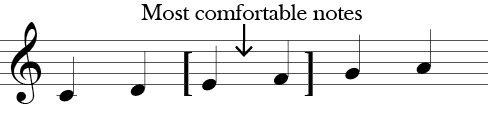
The goal is to have them not sing too far below the staff or too low in their voices, and to non push or strain their voices besides far in a higher place this range either. Singing should be light, in the child's head voice, never forced or pushed, and beautiful music-making should exist stressed.
Initially, children need to explore their voices to find out what they are capable of, and to commencement hearing that their voices do indeed have a range to them. It is very good for children to make low-cal, airy, and smoothen sounds in their head voice as they detect their individual sound.
Begin with some vocal exploration with speech, but getting them to loosen up and find their high, light head vox.
Vox exploration speech exercises
i. I take my voice up high
I have my voice upwardly high (starting time depression, and slide voice upwardly)
I bring my voice down low (Start high, and slide voice down)
I send my voice out into infinite (Loving cup easily around mouth and project)
I whisper all around, whisper, whisper (Whisper line and whisper to neighbors)
2. Bow wow
Bow wow, says the dog (medium phonation)
Meow, meow says the cat (loftier voice)
Grunt, grunt says the sus scrofa (depression vox)
Squeak, squeak says the rat (very high)
three. Elevator
Have the children pretend their vocalism is an elevator sliding up and down between floors. They can accompany their vocal exploration with physical moving up and down likewise, or the teacher may desire to have a focal object like a boob moving up and down that they can follow with their voice.
Pitch matching songs and games
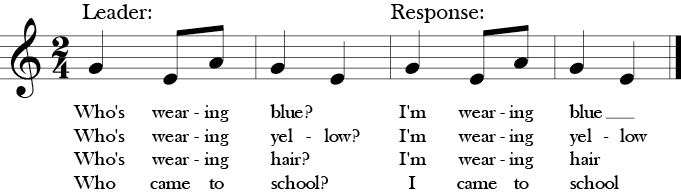
Begin with simple but interesting songs with small ranges. These songs can be varied and repeated, and help children sing accurately. "Who's Wearing Blue" is an first-class warm-up or opening action in a music class. What did the children wear? exercise? meet? There are countless, creative opportunities to ask them virtually their lives in a few notes.
Sol, mi, la songs
Who'southward Wearing Blue?
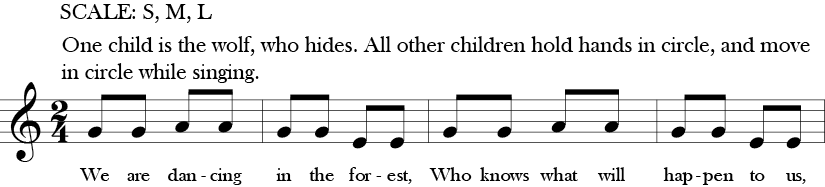
We are Dancing in the Wood

Mi, re, exercise songs
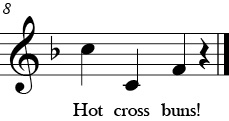
Hot Cross Buns
English traditional street cry, 1733


Elementary songs in a limited range
Rain, Rain Go Away
Traditional children's vocal, 17th century

Snail, Snail
Children course a unmarried line, property on the waist of the child in front of them. The child at the front of the line is the snail's head, who holds upwards and wiggles both index fingers on the forehead representing the snail'southward eyestalks. The line shuffles around the room imitating the slow, fluid motions of a snail.

Petty Sally H2o
Traditional American circle game song
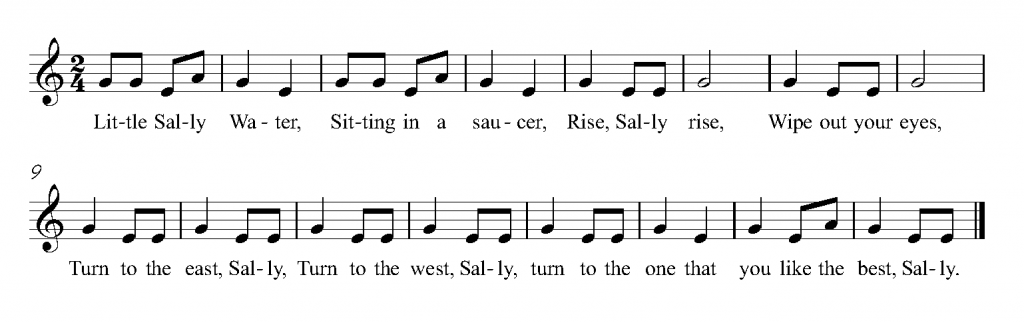
See Saw, Margery Daw
English plant nursery rhyme, 1765


I Accept Lost my Closet Key
American folk song


Accompanying game for "I Have Lost my Closet Key": Children sit in a circle. One child hides a key in their hand while another kid walks around the circle trying to guess who has the key while all sing Poesy ane. After finding the central, all sing Verse 2. That person then becomes "information technology" and some other is chosen to hibernate the key.
Au Clair de la Lune
French folk song


Ring Around the Rosy
English song attributed to 1665 Black Plague, but sources merely go dorsum to 19th century


Sally Go Circular the Sun


Rocky Mountain
Appalachian folk song




No Bears Out Tonight
One kid is the "bear" who hides while others count one o' clock to midnight.
Children search for the comport, then run dorsum to "dwelling" when the bear is found.


The Mulberry Bush
English nursery rhyme, 1840s


Instrumental Music Activities for Three to Five Years Erstwhile
Loftier/Low Pitches: You or a child plays a low instrument (pulsate, bass xylophone, etc.) and children respond past moving in low space. Then try the same for high-pitched instruments (triangle, tambourine, etc.), having them movement through high space.
Fast/Ho-hum Tempo and Loud/Soft Dynamics Game: Like to higher up, play instruments in different tempos and dynamics. Switch and mix them upwardly (fast and loud, soft and slow, fast and soft, irksome and loud), and if the child doesn't switch, he or she is out.
Contrasting Timbres: Assign a different movement to dissimilar timbres. For instance, a wood cake corresponds to a hop, a xylophone glissando is a leap, a shaker means to shake. Create an orchestra with one-half of the class playing and the other half responding. For more advanced children, create a choreographed and composed piece from the game.
Musical Simon Says: Review concepts learned such equally loud/soft, high/depression, or fast/slow. Simon says yell loud, Simon says whisper, Simon says sing high, Simon says groan low, etc.
Rhymes and Games
Poesy and rhymes are amongst the most basic forms of human expression, and both children and adults utilize poetry, rhymes, and games to tell stories, remember history, daydream, dream, and play. For immature children, the rhyme is magical as they outset encounter the powerful sound of rhyming words. Words create rhythmic patterns that captivate a child'due south attention. The natural rhythms inherent in rhyming can become the basis for exploration, improvisation, vocalizations, and instrumental creativity.
Rhymes with deportment, in item, are enjoyable to children because children alive through all of their senses and their whole torso. Adding motility helps reinforce the linguistic content of the rhyme or vocal. Movement and rhymes build cognitive abilities in terms of sequencing physical and linguistic activity, imitation, and internalization.
Adding Movement to Rhymes
At that place are many types of movement to add to rhymes and games. There are narrative movements, which are mimetic deportment that help to illustrate certain words and tell the story (e.yard., "I'm a Trivial Teapot"); abstract movements, which do not comport any specific linguistic significant, such as waving artillery or jumping; and rhythmic movements, which tin either emphasize the trounce of the rhyme or the rhythm of the text, such as clapping or torso percussion.
Narrative Movements: It is easy to add narrative movements to most children's rhymes as these poems often tell some type of story. Consider the rhyme "I'm a Little Ducky." Calculation swimming and flapping motions would be an obvious activity to add. Narrative motions not only bring the story to life, but likewise significantly help children to remember the words to a rhyme or song.
I'thou a little ducky swimming in the water
I'm a little ducky doing what I oughter
Took a bite of a lily pad
Flapped my wings and said, "I'thousand glad"
I'm a piffling ducky swimming in the h2o
Flap, flap, flap
Abstract Motions and Rhythmic Motions: Almost any not-locomotive or fifty-fifty some locomotive motions would piece of work here. Abstruse motions can hands be rhythmic also (due east.g., swaying to the beat, nodding the head to the beat out, tapping the rhythm of the words or shell, etc.).
Walking to the Crush: While a seemingly elementary-sounding practise, walking to the beat requires a physical awareness and near-abiding mental and physical adjustment to the walking stride in order to fit the trounce and tempo of the rhyme.
Example: Take whatever standard, well-known plant nursery rhyme. Walk to the trounce while maxim the rhyme. End precisely on the last beat of the rhyme and freeze!
Advanced: This game tin be further developed for older or more advanced children. Once they are walking to a steady vanquish and stopping precisely on the concluding beat, have children drop the recitation of the rhyme, and just walk the vanquish. See if they can all nevertheless stop on the last beat out! This helps students internalize the shell and phrases of the song.
Steady Beat Games
Pass the Beat out: Begin with a simple rhyme or song. While sitting in a circumvolve, have students pass a beanbag effectually the circumvolve on the beat. If the child misses, they are "out" or "in the soup" in the middle of the circle.
Bouncing Beat: Another game is to bounciness a ball to the beat of a simple song such as "Bounce High." This is a little more challenging because they accept to keep command of their bodies, voices, and a ball.
S, M, 50 vocal
Bounce Loftier

Action Songs
Head and Shoulders (Fundamental of F)




Shoo Fly
American folk vocal, 1863




Do You Know the Muffin Man?
English folk song, 1820


Did You Ever See a Lassie?
American folk song, late 19th century




Go to Sleep


If You lot're Ready for Music
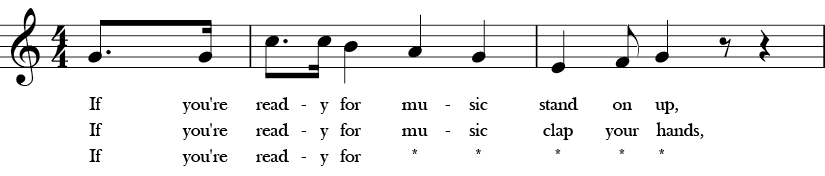
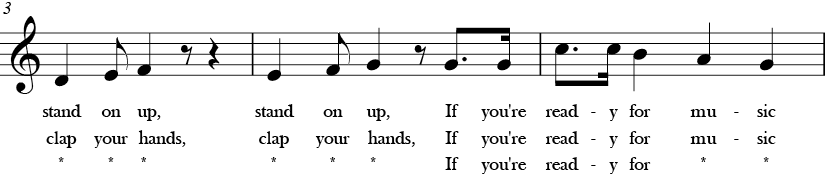
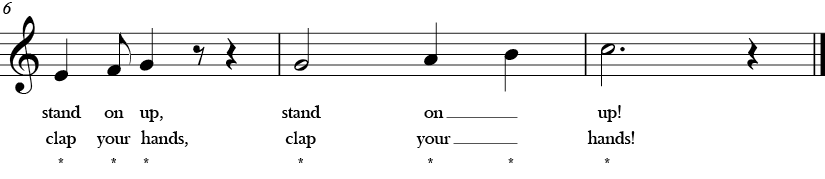
Rhymes
Deedle, Deedle Dumpling
Deedle, deedle dumpling, my son John
Went to bed with his stockings on
I shoe off and 1 shoe on
Deedle, deedle dumpling, my son John
Oliver Twist
Oliver Twist, Twist, Twist
Can't practise this, this, this
Bear upon his nose, olfactory organ, nose
Touch his toes, toes, toes
And effectually he goes, goes, goes
Rub, Rub
Rub, rub, rub
________'s in the tub
Rub her/him dry
Hang her high
Rub, rub, rub
Jingle Jive
Jingle, jingle, jingle jive
Move until you count to 5
1, 2, 3, iv, 5
Open up Shut Them
This is an action game song where the lyrics are imitated through motility using unproblematic actions in both hands.
Open Close Them


Open, close them, Open, shut them, (open and shut both hands)
Give a lilliputian clap, clap, clap (clap on each "handclapping")
Open, close them, Open up, shut them, (open and shut both easily)
Put them in y'all lap, lap, lap (tap open up hands on thighs)
Creep them, creep them, pitter-patter them, creep them, (clamber hands up to chin)
Right upward to your chin, chin, mentum (tap on each "mentum")
Open wide your piddling mouth (open up mouth)
But practise non put them in, in, in (tap on each "chin" again)
III. Musical Developmental Milestones in Young Children
Although we might not have thought of it, children's linguistic development is related to their musical development. Research shows a direct correlation betwixt the development of children's speech and their musical/singing ability, with music skills correlating significantly with both phonological awareness and reading development (Anvari et al., 2002).
While teachers of preschool children may have a sense of the linguistic milestones for children, they are less aware of the musical milestones. Since music and language development have a high correlation in terms of development, it is helpful to know what activities children are developmentally ready for musically, and when are they ready for them. For example, nigh four- and fifty-fifty five-year-olds are not yet able to play a steady beat on an instrument. Expecting them to will but frustrate both the children and yourself. The following chart indicates musical developmental ability by age, and will guide you lot in introducing musical skills and material that children are developmentally prepare for.
Musical Abilities by Age.
Historic period | Musical Behaviors | Appropriate Activities | Limitations |
| 0–ane year former (Infants) | Enjoy hearing:
| Enjoy:
| Cannot use linguistic communication or sing |
| 1–2 years former (Toddlers) |
|
| Cannot sing "in tune" but can maintain melodic contour Developmental Issues: "Centering" (pre-operational phase) can fix a child's attention on one perceptual feature. Difficulty seeing the larger transformational picture of some activities every bit attending is diverted past one feature. |
| 3-year-olds |
Enjoy:
|
|
Developmental Issues:
|
| iv-year-olds |
|
|
|
| 4–5-year-olds | Able to classify sounds equally:
|
Adopt:
| Crave many opportunities to match pitches and lodge direction of musical sounds in terms of going up, going down, and staying the same |
Activeness 8B
Endeavour this
Based on the chart to a higher place, respond the following in terms of what age is advisable for each activeness.
i. Analyzing/hearing the different sections of a song.
two. Responding vocally using different tones and inflections.
three. Singing the song "I'k a Nut."
iv. Echoing/responding to short, clapped rhythms.
five. Playing a steady beat on the xylophone or other percussion instrument.
6. Seeing abstract images and performing them either on voice or instruments.
Resources
Feierabend, J. (2011). Music and early childhood. Chicago: GIA Publications.
Songs for Pedagogy: Using Music to Promote Learning, Gari Stein http://www.songsforteaching.com/teachingtips/benefitsofmusicwithyoungchildren.htm
Early on Childhood Music and Movement Association (ECMMA) https://ecmma.org/
Children'southward Campsite Songs https://www.care.com/c/stories/3343/50-great-camp-songs-for-kids/
Music Notes: Music You Can Read http://musicnotes.net/SONGS/02-SARAS.html
Preschool Rhymes for Cocky and Family Themes (finger plays, action poems, songs and nursery rhymes) http://www.preschoolrainbow.org/family-rhymes.htm
References
Anvari, S., Trainor, L., Woodside, J., & Levy, A. (2002). Relations among musical skills, phonological processing, and early reading power in preschool children. Journal of Experimental Child Psychology, 83(2), 111–130.
Chen-Hafteck, L. (1997). Music and language development in early on childhood: Integrating past research in the two domains In Early Kid Development and Care 130 (one): 85-97.
Deliège, I. and Sloboda, J. (Eds.). (1996). Musical beginnings: Origins and evolution of musical competence. Oxford: Oxford Academy Printing.
Feierabend, J. (2001). Kickoff steps in classical music: Keeping the beat. Chicago, IL: GIA Publications.
Feierabend, J. (2006). Start steps in music for preschool and beyond : The curriculum. Chicago, IL: GIA Publications.
Gordon, E. E. (2007). Learning sequences in music: A contemporary music learning theory. Chicago, IL: GIA Publications.
Gordon, East. E. (2007). Learning sequences in music: A contemporary music learning
theory: Study guide. Chicago, IL: GIA Publications.
Gordon, E. Due east. (2007). Lecture cds for learning sequences in music: A gimmicky music learning theory. Chicago, IL: GIA Publications.
Gordon, E. (2000). Jump correct in: Class 1 instructor's guide—The general music serial (2nd ed.). Chicago, IL: GIA Publications.
Haroutounian, J. (2002). Kindling the spark: Recognizing and developing musical talent. Oxford: Oxford University Printing.
Jensen, E. (1998). Educational activity with the encephalon in mind. Alexandria, VA: ASCD Publisher.
Jordan-DeCarbo, J., and Galliford, J. (2011). The outcome of an age-appropriate music curriculum on motor and linguistic and nonlinguistic skills of children 3 to v years of age. In S. Burton & C. Taggart (Eds.), Learning from young children: Research in early childhood music (pp. 211–230). Lanham, MD: MENC and Rowman Littlefield.
Moore, R. S. (1991). Comparison of children'south and adults' vocal ranges and preferred tessituras in singing familiar songs.Message of the Quango for Research in Music Teaching, Winter, 13–22.
Reynolds, A., Bolton, B., Taggert, C., Valerio, W., & Gordon, E. (1998). Music play: The early on babyhood music curriculum guide. Chicago, IL: GIA Publications.
Suzuki, S., and Nagata, Chiliad. L. (1981). Ability evolution from age nix. Athens, OH: Suzuki Method International.
Turner, M. E. (2008). Listen, movement, think: Communicating through the languages of music and artistic movement. Retrieved from http://www.listenmovethink.com/#intro
Vocabulary
abstract movements: movements practice not behave whatsoever specific linguistic meaning, such as waving arms or jumping
articulation: the arroyo to playing a note and fashion of playing in terms of its smoothness, detachment, accents, etc.
dynamics: how loud or soft the music is
meter: meter determines where the stresses in music are, or how music stresses are grouped. A triple meter, for instance, will have groups of 3 with a stress on the starting time shell of the group. A duple meter will accept groups of 2 with a stress on the outset trounce of the group.
narrative movements: mimetic deportment that help to illustrate certain words and tell the story (due east.g., "I'thousand a Footling Teapot")
pitch: how high or low a note is
rhythmic movements: movements that can either emphasize the beat of the rhyme or the rhythm of the text, such as clapping or body percussion
tempo: how fast or slow the music is played
timbre: the quality of sound
Source: https://milnepublishing.geneseo.edu/music-and-the-child/chapter/chapter-8/
0 Response to "Kid Hopping on One Leg Squeaky Word Clip Art"
Post a Comment