In the Addition Reaction of Hi to 2-methyl-2-butene, What Is the First Step?
Reactions of Alkenes |
|---|
Addition Reactions of Alkenes
The most common chemical transformation of a carbon-carbon double bail is the addition reaction. A big number of reagents, both inorganic and organic, have been plant to add to this functional group, and in this section nosotros shall review many of these reactions. A majority of these reactions are exothermic, due to the fact that the C-C pi-bond is relatively weak (ca. 63 kcal/mole) relative to the sigma-bonds formed to the atoms or groups of the reagent. Remember, the bond energies of a molecule are the energies required to break (homolytically) all the covalent bonds in the molecule. Consequently, if the bail energies of the production molecules are greater than the bond energies of the reactants, the reaction volition be exothermic. The following calculations for the addition of H-Br are typical. Note that by convention exothermic reactions take a negative heat of reaction.

1. Addition of Strong Brønsted Acids
As illustrated by the preceding general equation, strong Brønsted acids such as HCl, HBr, HI & H2And then4, apace add to the C=C functional group of alkenes to give products in which new covalent bonds are formed to hydrogen and to the cohabit base of the acid. Using the above equation as a guide, write the addition products expected on reacting each of these reagents with cyclohexene.
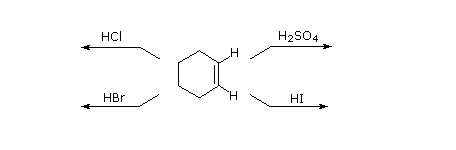 |
Weak Brønsted acids such as h2o (pKa = 15.7) and acetic acrid (pKa = four.75) practise not normally add together to alkenes. Notwithstanding, the addition of a strong acrid serves to catalyze the addition of water, and in this manner alcohols may be prepared from alkenes. For example, if sulfuric acrid is dissolved in water it is completely ionized to the hydronium ion, H3O(+), and this strongly acidic (pKa = -i.74) species effects hydration of ethene and other alkenes.
CHii=CHtwo + HiiiO (+) —— > HCHtwo–CHtwo OH + H (+)
The importance of choosing an appropriate solvent for these addition reactions should now be clear. If the addition of HCl, HBr or Hullo is desired, h2o and alcohols should not be used. These stiff acids volition ionize in such solvents to requite ROH2 (+) and the nucleophilic oxygen of the solvent will compete with the halide anions in the concluding footstep, giving alcohol and ether products. By using inert solvents such as hexane, benzene and methylene chloride, these competing solvent additions are avoided. Because these additions continue by mode of polar or ionic intermediates, the rate of reaction is greater in polar solvents, such as nitromethane and acetonitrile, than in non-polar solvents, such as cyclohexane and carbon tetrachloride.
Regioselectivity and the Markovnikov Rule
But 1 product is possible from the add-on of these strong acids to symmetrical alkenes such as ethene and cyclohexene. However, if the double bond carbon atoms are non structurally equivalent, equally in molecules of 1-butene, 2-methyl-2-butene and 1-methylcyclohexene, the reagent conceivably may add together in two different ways. This is shown for 2-methyl-ii-butene in the following equation.
| (CH3)twoC=CHCH3 + H-Cl |  | (CH3)2CH–CHClCHthree | or | (CHthree)2CCl–CHHCH3 |
| 2-methyl-2-butene | ii-chloro-3-methylbutane | 2-chloro-ii-methylbutane |
When addition reactions to such unsymmetrical alkenes are carried out, nosotros observe that 1 of the two possible constitutionally isomeric products is formed preferentially. Selectivity of this sort is termed regioselectivity. In the above example, 2-chloro-2-methylbutane is nearly the exclusive product. Similarly, 1-butene forms two-bromobutane equally the predominant production on treatment with HBr.

After studying many improver reactions of this kind, the Russian chemist Vladimir Markovnikov noticed a tendency in the construction of the favored add-on product. He formulated this trend as an empirical rule we now call The Markovnikov Rule: When a Brønsted acid, HX, adds to an unsymmetrically substituted double bail, the acidic hydrogen of the acid bonds to that carbon of the double bond that has the greater number of hydrogen atoms already attached to it.
In more than homelier colloquial this rule may be restated as, "Them that has gits."
| It is a helpful exercise to predict the favored production in examples such as those shown below: | |
|---|---|
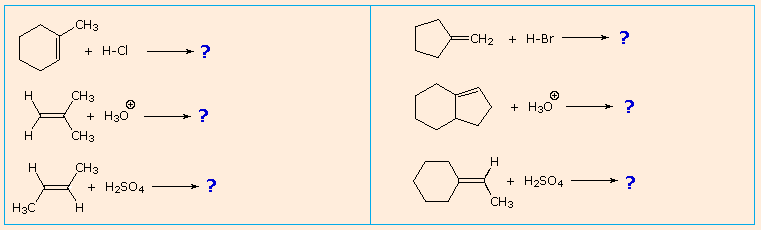 |
Empirical rules like the Markovnikov Rule are useful aids for remembering and predicting experimental results. Indeed, empirical rules are frequently the beginning pace toward applied mastery of a subject area, but they seldom constitute truthful agreement. The Markovnikov Dominion, for example, suggests at that place are mutual and important principles at work in these add-on reactions, but it does not tell us what they are. The next pace in achieving an understanding of this reaction must be to construct a rational mechanistic model that can be tested by experiment.
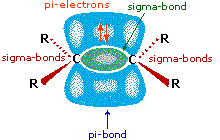 All the reagents discussed hither are strong Brønsted acids then, every bit a first step, information technology seems sensible to find a base with which the acid tin react. Since we know that these acids do not react with alkanes, it must be the pi-electrons of the alkene double bond that serve equally the base of operations. As shown in the diagram on the right, the pi-orbital extends into the infinite immediately above and below the plane of the double bond, and the electrons occupying this orbital may be attracted to the proton of a Brønsted acid. The resulting acid-base equilibrium generates a carbocation intermediate (the conjugate acrid of the alkene) which then combines quickly with the anionic conjugate base of the Brønsted acrid. This two-step machinery is illustrated for the reaction of ethene with hydrogen chloride by the following equations.
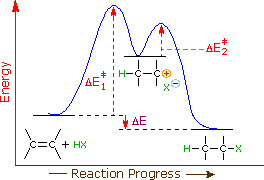 An free energy diagram for this two-pace addition mechanism is shown to the left. From this diagram nosotros see that the slow or rate-determining step (the start step) is also the product determining footstep (the anion volition necessarily bond to the carbocation site). Electron donating double bond substituents increase the reactivity of an alkene, as evidenced by the increased rate of hydration of 2-methylpropene (ii alkyl groups) compared with i-butene (ane alkyl group). Apparently, alkyl substituents act to increase the rate of addition by lowering the activation energy, ΔE‡ 1 of the charge per unit determining stride, and it is here nosotros should look for a rationalization of Markovnikov'southward rule.
As expected, electron withdrawing substituents, such as fluorine or chlorine, reduce the reactivity of an alkene to addition past acids (vinyl chloride is less reactive than ethene).
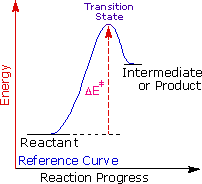 | Energy |
George Hammond formulated a useful principle that relates the nature of a transition state to its location on the reaction path. This Hammond Postulate states that a transition state volition be structurally and energetically similar to the species (reactant, intermediate or product) nearest to it on the reaction path. In strongly exothermic reactions the transition land will resemble the reactant species. In strongly endothermic conversions, such equally that shown to the right, the transition state will resemble the loftier-energy intermediate or product, and will track the energy of this intermediate if it changes. This change in transition state energy and activation energy as the stability of the intermediate changes may be observed past clicking the higher or lower buttons to the correct of the free energy diagram. 3 examples may be examined, and the reference curve is inverse to gray in the diagrams for higher (magenta) and lower (green) energy intermediates.
The carbocation intermediate formed in the first step of the add-on reaction at present assumes a key part, in that it straight influences the activation energy for this step. Independent research shows that the stability of carbocations varies with the nature of substituents, in a manner similar to that seen for alkyl radicals. The exceptional stability of allyl and benzyl cations is the result of accuse delocalization, and the stabilizing influence of alkyl substituents, although less pronounced, has been interpreted in a similar style.
| Carbocation Stability | CH3 (+) | < | CHthreeCH2 (+) | < | (CH3)2CH(+) | ≈ | CHii=CH-CH2 (+) | < | C6H5CH2 (+) | ≈ | (CH3)3C(+) |
|---|
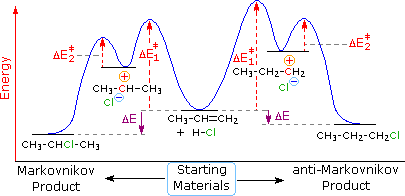
From this information, applying the Hammond Postulate, we arrive at a plausible rationalization of Markovnikov's rule. When an unsymmetrically substituted double bond is protonated, nosotros expect the more stable carbocation intermediate to exist formed faster than the less stable culling, because the activation energy of the path to the former is the lower of the two possibilities. This is illustrated by the following equation for the improver of hydrogen chloride to propene. Note that the initial acid-base of operations equilibrium leads to a pi-complex which immediately reorganizes to a sigma-bonded carbocation intermediate. The more stable 2º-carbocation is formed preferentially, and the conjugate base of the Brønsted acid (chloride anion in the example shown beneath) then rapidly bonds to this electrophilic intermediate to form the concluding product.
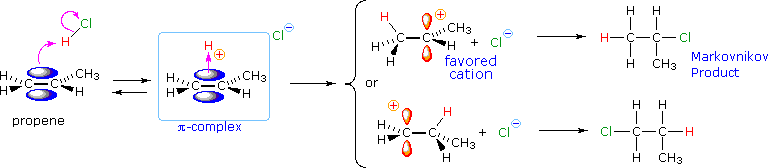
The following energy diagram summarizes these features. Notation that the pi-complex is non shown, since this rapidly and reversibly formed species is common to both possible reaction paths.
| A more than all-encompassing give-and-take of the factors that influence carbocation stability may be accessed by Clicking Here. |
|---|
2. Rearrangement of Carbocations
The formation of carbocations is sometimes accompanied past a structural rearrangement. Such rearrangements take place by a shift of a neighboring alkyl group or hydrogen, and are favored when the rearranged carbocation is more stable than the initial cation. The add-on of HCl to 3,iii-dimethyl-1-butene, for example, leads to an unexpected product, 2-chloro-two,3-dimethylbutane, in somewhat greater yield than 3-chloro-two,two-dimethylbutane, the expected Markovnikov product. This surprising result may be explained past a carbocation rearrangement of the initially formed 2º-carbocation to a 3º-carbocation by a one,ii-shift of a methyl group. To run across this rearrangement click the "Evidence Mechanism" button to the correct of the equation.
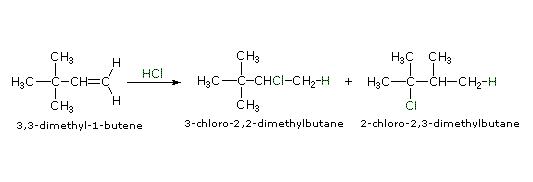 |
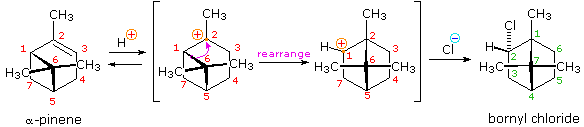
Another factor that may induce rearrangement of carbocation intermediates is strain. The addition of HCl to α-pinene, the major hydrocarbon component of turpentine, gives the rearranged product, bornyl chloride, in high yield. Every bit shown in the following equation, this rearrangement converts a 3º-carbocation to a 2º-carbocation, a transformation that is normally unfavorable. Notwithstanding, the rearrangement besides expands a strained 4-membered ring to a much less-strained five-membered band, and this relief of strain provides a driving force for the rearrangement. A three-dimensional project view of the rearrangement may be seen by clicking the "Other View" button. The cantlet numbers (colored red) for the pinene structure are retained throughout the rearrangement to help orient the viewer. The green numbers in the final product stand for the proper numbering of this bicyclic ring arrangement.
 |
The propensity for structural rearrangement shown past certain molecular constitutions, as illustrated above, serves as a useful probe for the intermediacy of carbocations in a reaction. We shall use this test later.
| An all-encompassing and more detailed give-and-take of cation induced rearrangements may be accessed by Clicking Here. |
|---|

3. Addition of Lewis Acids (Electrophilic Reagents)
The proton is not the only electrophilic species that initiates addition reactions to the double bail. Lewis acids like the halogens, boron hydrides and sure transition element ions are able to bail to the alkene pi-electrons, and the resulting complexes rearrange or are attacked by nucleophiles to give improver products. The electrophilic character of the halogens is well known. Although fluorine is uncontrollably reactive, chlorine, bromine and to a bottom caste iodine react selectively with the double bail of alkenes. The addition of chlorine and bromine to alkenes, as shown in the post-obit general equation, proceeds by an initial electrophilic attack on the pi-electrons of the double bail. Iodine adds reversibly to double bonds, but the equilibrium does non normally favor the add-on product, so it is not a useful preparative method. Dihalo-compounds in which the halogens are juxtaposed in the manner shown are called vicinal, from the Latin vicinalis, meaning neighboring.
Other element of group vii containing reagents which add to double bonds include hypohalous acids, HOX, and sulfenyl chlorides, RSCl. These reagents are unsymmetrical, and so their addition to unsymmetrical double bonds may in principle have place in two ways. In practice, these addition reactions are regioselective, with one of the 2 possible constitutionally isomeric products being favored. The electrophilic moiety of these reagents is the halogen.
(CH3)2C=CH2 + HOBr —— > (CH3)2COH-CH2 Br
(CHiii)twoC=CH2 + CsixH5 SCl —— > (CH3)twoCCl-CHii SC6Hv
The regioselectivity of the in a higher place reactions may be explained by the same mechanism nosotros used to rationalize the Markovnikov dominion. Thus, bonding of an electrophilic species to the double bond of an alkene should result in preferential germination of the more than stable (more highly substituted) carbocation, and this intermediate should and then combine quickly with a nucleophilic species to produce the addition product. This is illustrated by the following equation.

To use this mechanism we need to decide the electrophilic moiety in each of the reagents. 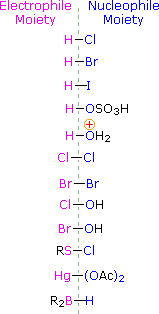 By using electronegativity differences nosotros can dissect mutual add-on reagents into electrophilic and nucleophilic moieties, every bit shown on the right. In the instance of hypochlorous and hypobromous acids (HOX), these weak Brønsted acids (pKa'south ca. 8) do not react every bit proton donors; and since oxygen is more than electronegative than chlorine or bromine, the electrophile volition be a halide cation. The nucleophilic species that bonds to the intermediate carbocation is and so hydroxide ion, or more probable h2o (the usual solvent for these reagents), and the products are chosen halohydrins. Sulfenyl chlorides add in the opposite fashion because the electrophile is a sulfur cation, RS(+), whereas the nucleophilic moiety is chloride anion (chlorine is more electronegative than sulfur).
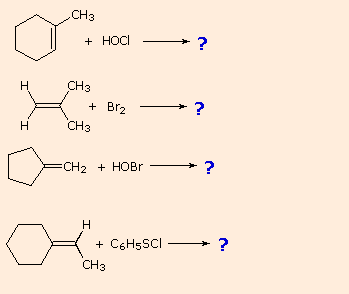
| If you lot understand this mechanism you should be able to write products for the following reactions: | |
 | |
The improver products formed in reactions of alkenes with mercuric acetate and boron hydrides (compounds shown at the lesser of of the reagent list) are normally not isolated, but instead are converted to alcohols by a substitution reaction. These important synthetic transformations are illustrated for 2-methylpropene by the following equations, in which the electrophilic moiety is colored ruby-red and the nucleophile blue. The top reaction sequence illustrates the oxymercuration procedure and the bottom is an example of hydroboration.
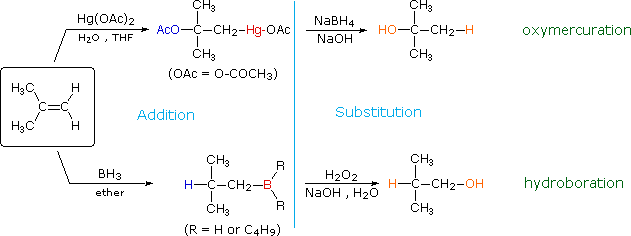
The light blue vertical line separates the improver reaction on the left from the commutation on the right. The atoms or groups that have been added to the original double bail are colored orangish in the final production. In both cases the overall reaction is the addition of h2o to the double bail, merely the regioselectivity is reversed. The oxymercuration reaction gives the product predicted by Markovnikov'south rule; hydroboration on the other hand gives the "anti-Markovnikov" product. Complementary reactions such as these are important because they permit u.s. to direct a molecular transformation whichever style is desired.
Mercury and boron are removed from the organic substrate in the second step of oxymercuration and hydroboration respectively. These reactions are seldom discussed in item; however, it is worth noting that the mercury moiety is reduced to metallic mercury by borohydride (probably by way of radical intermediates), and boron is oxidized to borate by the alkaline metal peroxide. Addition of hydroperoxide anion to the electrophilic borane generates a tetra-coordinate boron peroxide, having the general formula R3B-O-OH(-). This undergoes successive intramolecular shifts of alkyl groups from boron to oxygen, accompanied in each outcome by additional peroxide addition to electron scarce boron. The retentiveness of configuration of the migrating alkyl group is attributed to the intramolecular nature of the rearrangement.
Since the oxymercuration sequence gives the same hydration production as acid-catalyzed addition of h2o (come across Brønsted acrid addition), nosotros might question why this two-step procedure is used at all. The reason lies in the milder reaction weather used for oxymercuration. The strong acid used for direct hydration may not be tolerated by other functional groups, and in some cases may cause molecular rearrangement (see above).
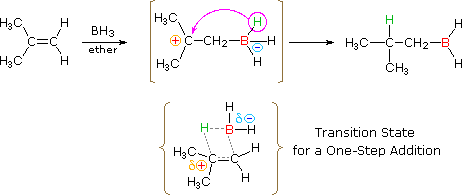
The add-on of borane, BH3, requires additional annotate. In pure class this reagent is a dimeric gas BtwoH6, called diborane, but in ether or THF solution information technology is dissociated into a solvent coordinated monomer, R2O-BH3. Although diborane itself does not react easily with alkene double bonds, H.C. Brownish (Purdue, Nobel Prize 1979) discovered that the solvated monomer adds chop-chop under mild conditions. Boron and hydrogen have rather like electronegativities, with hydrogen being slightly greater, then it is non probable there is pregnant dipolar grapheme to the B-H bail. Since boron is electron scarce (it does not take a valence crush electron octet) the reagent itself is a Lewis acrid and tin bond to the pi-electrons of a double bail past displacement of the ether moiety from the solvated monomer. Equally shown in the following equation, this bonding might generate a dipolar intermediate consisting of a negatively-charged boron and a carbocation. Such a species would not be stable and would rearrange to a neutral product past the shift of a hydride to the carbocation center. Indeed, this hydride shift is believed to occur concurrently with the initial bonding to boron, every bit shown by the transition state drawn below the equation, so the discrete intermediate shown in the equation is non really formed. Notwithstanding, the carbocation stability rule cited above remains a useful way to predict the products from hydroboration reactions. You may correct the top equation past clicking the button on its right. Annotation that this improver is unique among those we have discussed, in that it is a single-step process. Also, all three hydrogens in borane are potentially reactive, so that the alkyl borane product from the first add-on may serve as the hydroboration reagent for two additional alkene molecules.
 | |
To examine models of B2H6. and its dissociation in THF
Stereoselectivity in Addition Reactions to Double Bonds
As illustrated in the drawing on the right, the pi-bond fixes the carbon-carbon double bond in a planar configuration, and does not permit free rotation about the double bond itself. We run into then that addition reactions to this role might occur in three unlike ways, depending on the relative orientation of the atoms or groups that add to the carbons of the double bond: (i) they may bond from the aforementioned side, (2) they may bail from opposite sides, or (iii) they may bail randomly from both sides. The start two possibilities are examples of stereoselectivity, the first being termed syn-addition, and the second anti-addition. Since initial electrophilic attack on the double bond may occur every bit well from either side, information technology is in the 2nd footstep (or stage) of the reaction (bonding of the nucleophile) that stereoselectivity may exist imposed.
If the two-step mechanism described above is right, and if the carbocation intermediate is sufficiently long-lived to freely-rotate about the sigma-bond component of the original double bond, we would expect to find random or not-stereoselective addition in the products. On the other manus, if the intermediate is brusk-lived and factors such as steric hindrance or neighboring grouping interactions favor one side in the second step, then stereoselectivity in product formation is probable. The following table summarizes the results obtained from many studies, the formula HX refers to all the strong Brønsted acids. The interesting differences in stereoselectivity noted hither provide further insight into the mechanisms of these addition reactions.
| Reagent | H–X | X2 | HO–X | RS–Cl | Hg(OAc)2 | BHthree |
|---|---|---|---|---|---|---|
| Stereoselectivity | mixed | anti | anti | anti | anti | syn |
i. Brønsted Acid Additions
The stereoselectivity of Brønsted acid improver is sensitive to experimental conditions such as temperature and reagent concentration. The selectivity is often anti, simply reports of syn selectivity and not-selectivity are not uncommon. Of all the reagents discussed here, these stiff acid additions (E = H in the following equation) come up closest to proceeding past the proposed two-stride mechanism in which a discrete carbocation intermediate is generated in the first step. Such reactions are most prone to rearrangement when this is favored by the alkene structure.
2. Add-on Reactions Initiated by Electrophilic Halogen
The halogens chlorine and bromine add rapidly to a wide variety of alkenes without inducing the kinds of structural rearrangements noted for strong acids (first instance below). The stereoselectivity of these additions is strongly anti, every bit shown in many of the following examples.
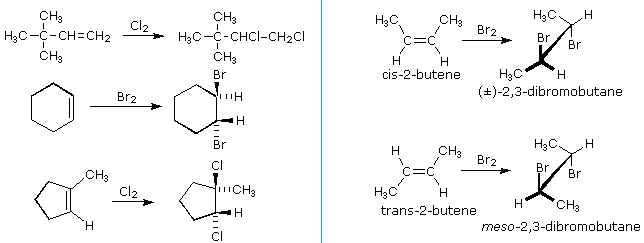
An of import principle should be restated at this time. The alkenes shown here are all achiral, merely the improver products have chiral centers, and in many cases may exist as enantiomeric stereoisomers. In the absence of chiral catalysts or reagents, reactions of this kind will always give racemic mixtures if the products are enantiomeric. On the other hand, if two chiral centers are formed in the improver the reaction will be diastereomer selective. This is clearly shown past the addition of bromine to the isomeric 2-butenes. Anti-addition to cis-2-butene gives the racemic product, whereas anti-improver to the trans-isomer gives the meso-diastereomer.
We can account both for the high stereoselectivity and the lack of rearrangement in these reactions by proposing a stabilizing interaction between the developing carbocation middle and the electron rich halogen atom on the adjacent carbon. This interaction, which is depicted for bromine in the following equation, delocalizes the positive charge on the intermediate and blocks halide ion set on from the syn-location.

The stabilization provided by this halogen-carbocation bonding makes rearrangement unlikely, and in a few cases three-membered cyclic halonium cations have been isolated and identified as true intermediates. A resonance description of such a bromonium ion intermediate is shown below. The positive charge is delocalized over all the atoms of the band, simply should be concentrated at the more substituted carbon (carbocation stability), and this is the site to which the nucleophile will bail.

| The stereoselectivity described here is in big part due to a stereoelectronic effect. |
|---|
Because they proceed past way of polar ion-pair intermediates, chlorine and bromine addition reactions are faster in polar solvents than in not-polar solvents, such as hexane or carbon tetrachloride. Nonetheless, in social club to prevent solvent nucleophiles from competing with the halide anion, these non-polar solvents are often selected for these reactions. In water or booze solution the nucleophilic solvent may open up the bromonium ion intermediate to give an α-halo-booze or ether, together with the expected vic-dihalide. Such reactions are sensitive to pH and other factors, so when these products are desired it is necessary to modify the addition reagent. Aqueous chlorine exists every bit the post-obit equilibrium, Thousandeq ≈ 10-4. By adding AgOH, the concentration of HOCl tin be greatly increased, and the chlorohydrin addition product obtained from alkenes.
| Cl2 + HtwoO |  | HOCl + HCl |
The more widely used HOBr reagent, hypobromous acrid, is commonly made by hydrolysis of N-bromoacetamide, as shown below. Both HOCl and HOBr additions occur in an anti way, and with the regioselectivity predicted by this machinery (OH bonds to the more than substituted carbon of the alkene).
| CH3CONHBr + H2O | | HOBr + CHiiiCONH2 |
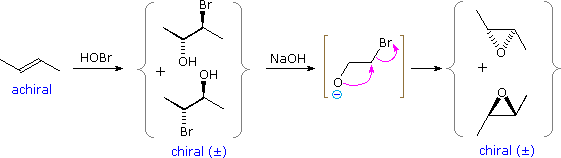
Vicinal halohydrins provide an alternative route for the epoxidation of alkenes over that of reaction with peracids. As illustrated in the following diagram, a base of operations induced intramolecular exchange reaction forms a three-membered cyclic ether called an epoxide. Both the halohydrin germination and halide displacement reactions are stereospecific, and then stereoisomerism in the alkene will be reflected in the epoxide product (i.e. trans-2-butene forms a trans-disubstituted epoxide). A full general process for forming these useful compounds will be discussed in the next section.
| Other Addition Reactions |
|---|
This page is the property of William Reusch. Comments, questions and errors should be sent to whreusch@msu.edu.
These pages are provided to the IOCD to assist in capacity edifice in chemical education. 05/05/2013
Source: https://www2.chemistry.msu.edu/faculty/reusch/virttxtjml/addene1.htm
0 Response to "In the Addition Reaction of Hi to 2-methyl-2-butene, What Is the First Step?"
Post a Comment